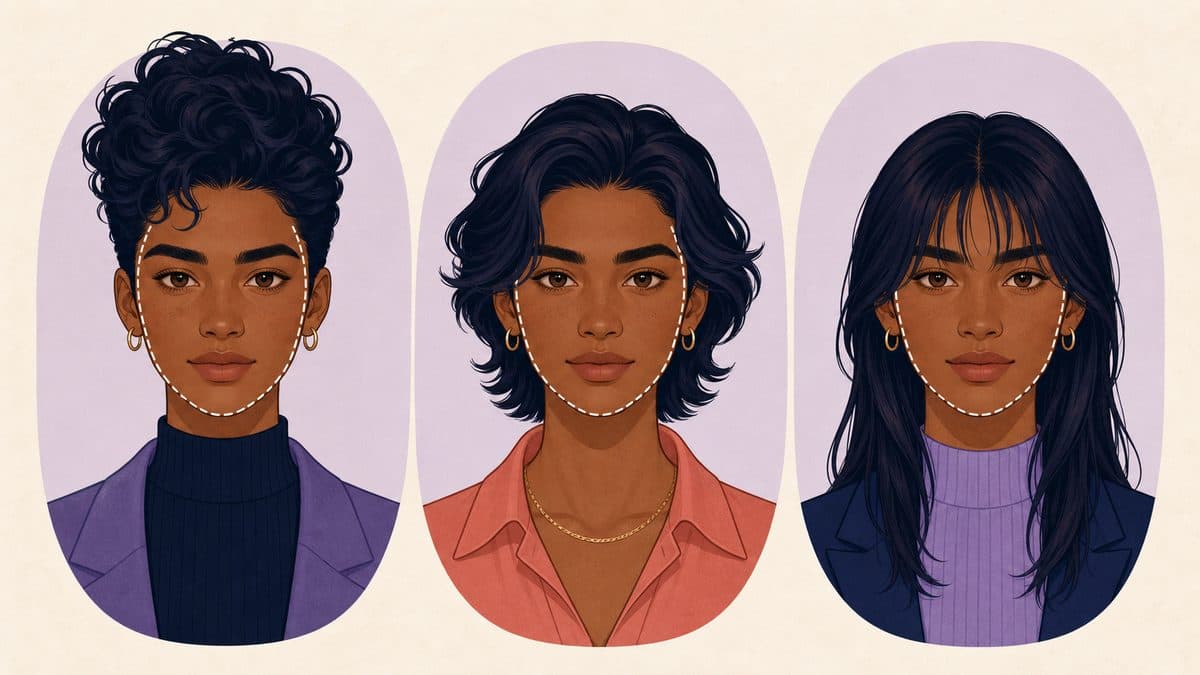
Volume placement changes the outer proportions
Height at the crown extends the vertical silhouette and can make a face look longer. Width at the temples or cheeks expands the horizontal silhouette. Volume near the jaw can add presence to a narrow lower face, while very close sides expose the natural outline more strongly.
The effect is independent of gender or haircut name. A coiled high-top, lifted pixie, textured quiff, or high updo can all add vertical emphasis. A rounded bob, wide curls, layered waves, or fuller temple shape can all add horizontal emphasis.
Hair length creates vertical or horizontal lines
Long, relatively straight lengths create strong downward lines, especially when the sides remain flat. A cut ending at the chin or jaw creates a horizontal endpoint that draws attention to that level. Short cuts expose more of the cheeks, jaw, and neck, so shape and edge placement become more visible.
Length alone does not determine the effect. Long curls with generous side volume can widen the silhouette, while a short style with high crown volume can lengthen it.
Bangs and fringe change visible face length
A full fringe covers part of the upper face and breaks the uninterrupted vertical distance from hairline to chin. Curtain fringe creates two diagonal framing lines. A side-swept fringe adds asymmetry, while an airy fringe creates a softer break and retains more visible upper-face area.
Fringe also affects perceived width. A broad blunt line can emphasize the horizontal upper face, while a narrow split leaves more vertical space at the centre.
Centre and side parts guide the eye differently
A centre part reinforces bilateral symmetry and a central vertical line. A side part creates a diagonal and shifts visible volume from one side to the other. A deep side part can add width across the top and interrupt a long vertical impression.
Neither part is universally better. Choose the direction that supports the effect you want and works with growth patterns, density, and daily maintenance.
Layers, texture, and face framing
Layers
Layers determine where movement begins and where ends accumulate. Layers starting near the cheek draw attention there; layers opening near the jaw can add lower width; long blended layers preserve a more vertical outline.
Texture
Waves, curls, coils, and textured styling create volume in three dimensions. The relevant question is not whether texture suits a face shape, but where the chosen shape places that texture.
Face-framing pieces
Pieces that angle inward visually narrow the area they border. Pieces that curve outward or end with fullness can add width. The same technique can be subtle or dramatic depending on density and contrast.
Examples for all seven face shapes
Oval
Oval proportions can carry many silhouettes without a corrective goal. High volume and very flat sides add extra length; a fringe or side width reduces it. Use the oval guide to identify the baseline curve.
Round
Crown height, diagonal fringe, and lengths that continue below the cheeks add vertical direction. Width concentrated exactly at the fullest cheek emphasizes roundness, which may be the desired effect. Compare the round outline.
Square
Waves, curls, wispy edges, and offset parts contrast with a geometric jaw. Blunt jaw-level lines repeat its structure. Both approaches are valid depending on whether you want softness or definition. See the square guide.
Heart
Movement near the jaw and lower sides can balance a broader visible upper face. Strong crown height with close lower sides emphasizes the taper. The heart guide explains that upper-to-lower relationship.
Diamond
Temple presence and jaw-level movement distribute width above and below prominent cheekbones. Maximum volume only at cheek level repeats the diamond peak. Review the diamond guide.
Oblong
Side volume, fringe, and moderate crown height reduce vertical emphasis. Very long flat sides plus a tall top create the strongest lengthening effect. Use the oblong guide for the side-outline clues.
Triangle
Volume at the temples and upper sides can balance a broad jaw. Very close temples expose the lower width more strongly. The triangle guide shows how jaw width leads the pattern.
Perception changes, structure does not
Hair changes contrast, framing, and the outer silhouette. It can hide or expose parts of the face, but it does not turn the underlying bone and soft-tissue structure into a different shape. This is why the same person may receive different casual guesses with hair up and hair down.
For identification, move hair away and use the manual face-shape guide. For styling, put the hair back into the decision and focus on the effect you enjoy.
How to choose an effect in practice
- Decide whether you want to add visible length, width, softness, structure, or asymmetry.
- Identify where the style places its maximum volume.
- Notice where the perimeter ends relative to cheeks and jaw.
- Choose fringe and parting by the line they create, not by a rigid face-shape rule.
- Adapt the silhouette to texture, density, growth direction, condition, climate, and maintenance.
- Bring reference images to a stylist and discuss how the effect translates to your hair.
Use face shape as one input
The complete hairstyles by face shape hub offers practical principles for each category, but comfort and personal style come first. If you are unsure of the baseline pattern, analyze a clear photo and read the explanation rather than treating the label as a beauty rule.
If your result sits between two categories, the guide to mixed face shapes shows how to borrow one useful principle from each.
Frequently asked questions
Can a haircut actually change my face shape?
It changes the perceived outline and emphasis, not the underlying facial structure. Hair can add or remove visible length, width, and framing.
Do bangs make every face look shorter?
They usually reduce uninterrupted visible upper-face length, but the exact effect depends on density, width, split, texture, and where the fringe ends.
Is a centre part bad for a round or long face?
No. A centre part emphasizes symmetry and a vertical centre line. Wear it if you like that effect, or add side volume, fringe, or layers if you want a different balance.
Can curly or coily hair use face-shape guidance?
Yes. Focus on the outer silhouette and where volume is placed. There is no need to copy a straight-hair cut or suppress natural texture.
Should face shape decide my haircut?
No. It is one visual input alongside texture, density, condition, growth patterns, maintenance, culture, comfort, and personal preference.