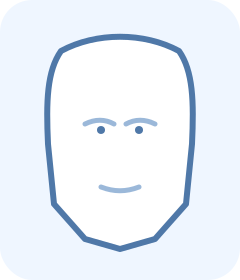
The defining lower-face structure
The jaw is more useful than cheek fullness for identifying a square outline. From the front, the sides descend with limited taper and turn at a visible angle near the jaw corners.
- Upper and lower face have comparable width
- Face length does not strongly dominate
- Jaw corners are distinct
- Chin is broad rather than sharply pointed
Check the jaw before measuring
Use an eye-level image with the head straight. Look at both jaw corners and compare their distance with the visible upper-face width. Then use length-to-width as confirmation, not the only deciding number.
Square, round, or triangle?
Round and square faces can have similar overall ratios, but round outlines curve where square outlines turn. Triangle faces also have a broad jaw, though the upper face appears narrower and the outline expands downward.
| Feature | Square | Round | Triangle |
|---|---|---|---|
| Jaw corners | Clear | Soft | Clear or broad |
| Upper face | Similar to jaw | Curved balance | Narrower than jaw |
| Chin | Broad | Rounded | Broad or tapered |
Hairstyle direction
Texture and movement can soften a strong geometric outline; clean edges can emphasize it. Neither is required. Consider where a cut ends, because a blunt line directly at the broadest jaw point reinforces horizontal width.
- Short hair: choose either purposeful structure or softer texture around the corners.
- Longer hair: layers beginning below or above the jaw avoid a single heavy line at it.
- Fringes and parts: diagonal or broken lines add asymmetry; straight lines emphasize geometry.
- Coils and curls: use the outer silhouette to place volume, without treating natural texture as a problem.
Eyewear direction
Round, oval, or softly upswept frames add curve; rectangular frames echo the jaw. Frame width should align with the broad face width, and the temples should not press at the sides.
- Use lens depth to control how strong or light the frame appears.
- Check bridge and nose-pad fit independently of the shape recommendation.
- Do not size down simply to avoid a bold frame.
Mixed results and photo effects
A longer square outline may score near oblong, while softened jaw visibility may push a result toward round. A camera placed below the face can exaggerate the jaw. Recheck from eye level.
Identification errors
Do not classify a face as square from a single sharp jaw angle in a three-quarter portrait. The category depends on the front-facing relationship between the upper face, cheeks, jaw, and length.
Frequently asked questions
Can a square face be longer than it is wide?
Yes. The lengths do not have to be identical. A moderate length difference can still fit square when the sides remain broad and the jaw structure dominates.
Does a strong jaw always mean square?
No. Triangle, oblong, and mixed outlines can also have defined jaws. Compare jaw width with the upper face and total length.