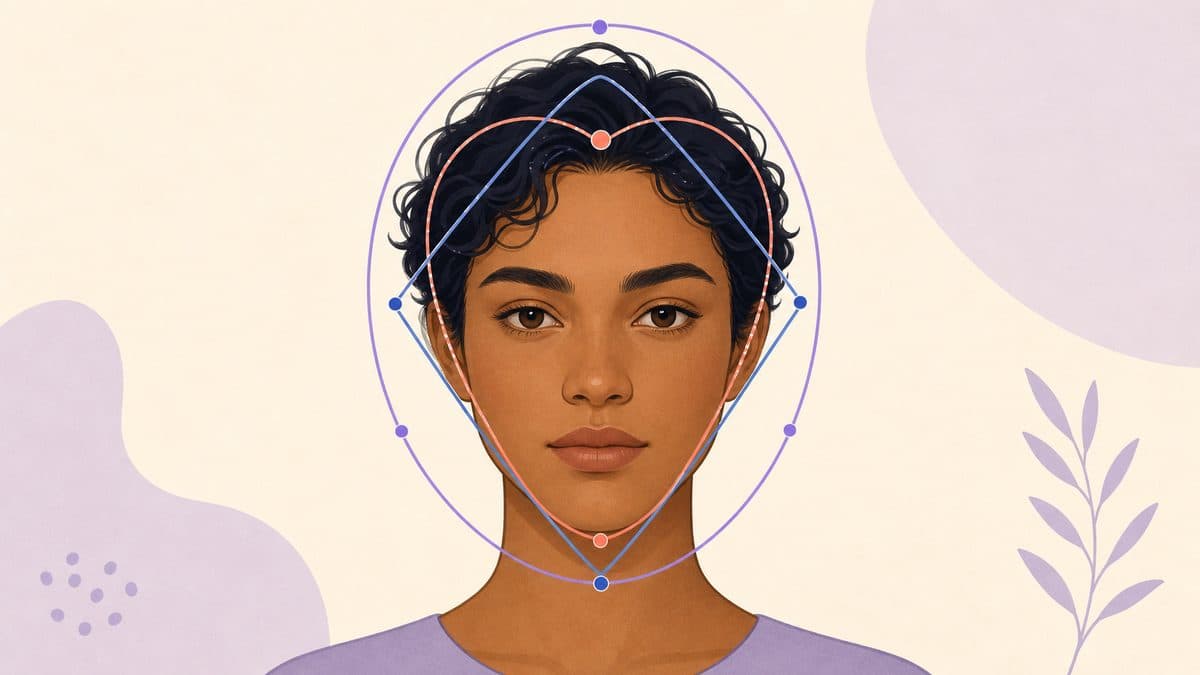
Categories simplify natural variation
Seven labels make comparison and styling guidance manageable. They do not create hard biological boundaries. A face can move gradually from oval-like to oblong-like proportions without crossing an objective line that everyone uses.
What similarity scores mean
This tool compares visible proportion features with project-defined reference patterns. Match scores show how the current photo distributed across those patterns. They are not scientific accuracy or diagnostic confidence, and a close secondary score highlights genuine overlap or uncertain photo evidence.
Practical mixed examples
- Oval-oblong: moderate cheek curve with stronger-than-average length.
- Round-oval: soft jaw and cheeks with length slightly greater than width.
- Heart-diamond: tapered jaw with width shared between upper face and cheekbones.
- Square-triangle: defined broad jaw with an upper face only slightly narrower.
- Oval-heart: balanced length with a narrower chin and gentle upper-to-lower taper.
Separate overlap from a poor photo
Retake the image if the face is turned, tilted, small, blurred, unevenly lit, or partly covered. If the same two categories remain close across a consistent photo and a manual check, the mixed description is probably more useful than chasing a single label.
Choose styling advice feature by feature
You do not need to select one complete rule set. If an oval-oblong mix feels too long with high hair, borrow the oblong principle of side volume. If a heart-diamond mix has prominent cheekbones, use frame width advice from diamond and lower-volume hair ideas from heart.
When to try another image
Retake once when quality guidance identifies a specific issue. Repeating many uncontrolled selfies is more likely to add noise than clarity. Use a manual comparison after one or two careful attempts.
A useful way to state the result
Say, 'My closest match is oval, with some oblong characteristics.' That wording preserves the main pattern and the feature that makes your proportions individual.
Use the face-shape hub to name the overlapping features, apply them flexibly in the hairstyle guide, and analyze a controlled photo only when you want another informal comparison. The heart versus diamond guide shows how this works for two commonly mixed shapes.
Frequently asked questions
Does a mixed result mean the detector failed?
No. It may reflect real overlap. Check the photo-quality note and compare the actual reasons listed for each score.
Can face shape change over time?
The visible outline can change with soft tissue, hair, facial hair, and age. The category may shift at the edges even when underlying structure changes little.
Which shape should I use for hairstyles?
Use the primary pattern as a starting point, then borrow the secondary shape's advice for the specific feature you want to balance or emphasize.