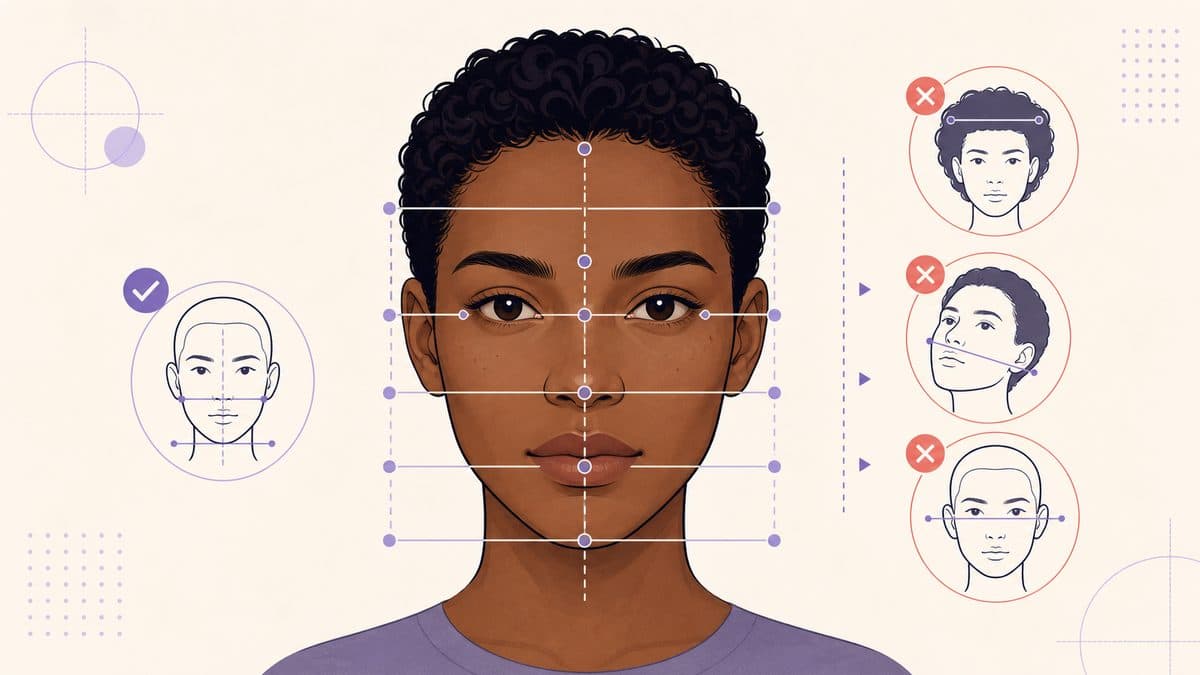
Mistake 1: choosing inconsistent measuring points
A measurement becomes useless when its endpoints change between attempts. Cheek width should describe the most prominent visible cheekbone span, not the ears. Jaw width should compare corresponding lower corners, not whichever shadow looks widest.
Mark the endpoints before reading the distance. Use the same definition on both sides and on every comparison photo. If an edge is hidden, record the measurement as uncertain rather than guessing.
Mistake 2: measuring over hair
Hair adds an outer silhouette that can make the upper face or cheeks look wider. Hairstyle height should not be included in visible face length, and side volume should not become cheek width.
Pull hair away from the temples, cheeks, and jaw without pulling the skin. If the true hairline is not visible, use a stable visible upper-face reference and describe the resulting length as approximate.
Mistake 3: using an angled photograph
A turned head makes the nearer side look larger and hides the far edge. A tilted head changes the vertical axis, and a camera above or below eye level changes upper-to-lower taper. Measurements from that image may be internally precise but still describe perspective rather than the face.
Retake the photo with the lens at eye level, the nose centred, and both eyes on a level line. The phone camera guide gives a complete setup.
Mistake 4: confusing head shape with face shape
Face-shape categories describe the visible facial outline from the upper face to the chin. They do not describe the full skull, hairstyle, ears, or the back of the head. Measuring the widest part of the head over hair or including ear width mixes different structures.
Keep the comparison inside the visible facial edges. The seven-shape reference shows which relationships each category actually uses.
Mistake 5: ignoring the jawline
Length and cheek width may place two shapes close together, but the lower outline often separates them. Round and square can share compact proportions; heart and diamond can share a narrow chin; oval and oblong can both be longer than wide.
After measuring, trace the jaw from each lower corner to the chin. Record whether it curves continuously, holds width, shows clear corners, or tapers strongly.
Mistake 6: using only one measurement
No single length or width determines face shape. A long face can be oval or oblong depending on side curvature and jaw width. A wide cheek span can appear in round, oval, heart, or diamond patterns depending on the upper and lower outline.
Use a sequence: compare length with maximum width, locate the widest region, compare upper-face and jaw widths, then assess jaw and chin shape. The full manual measurement guide walks through this order.
Mistake 7: overinterpreting small differences
A few pixels can change with image resolution, landmark placement, expression, or where you click. If two widths are almost the same, report them as similar. Do not turn a tiny difference into a confident category decision.
For example, cheek width that appears one percent greater than upper-face width does not automatically prove diamond. Ask whether the visual middle peak remains clear across a good photo and a mirror check.
A corrected measurement sequence
| Step | What to compare | What to avoid |
|---|---|---|
| 1 | Straight, eye-level photo quality | Tilt, turn, close lens, uneven light |
| 2 | Visible face length and maximum facial width | Hair height and ear-to-ear width |
| 3 | Upper-face, cheek, and jaw relationships | Mixing endpoints between measurements |
| 4 | Jaw curve, corners, and taper | Letting cheek width decide everything |
| 5 | Chin shape as confirmation | Choosing a category from the chin alone |
| 6 | Overall pattern and close secondary match | False precision from tiny differences |
Clear examples of better interpretation
- If length is moderately greater than width and the jaw tapers softly, oval is more useful than an exact ratio cutoff.
- If length and width are close, compare a curved jaw with a broad cornered jaw before choosing round or square.
- If the chin is narrow, locate whether the upper face or cheekbones create the widest area before choosing heart or diamond.
- If the jaw is broad, compare it with upper-face width before choosing square or triangle.
- If two patterns remain close, describe a primary and secondary shape instead of manipulating endpoints to force one answer.
Use measurement as a cross-check
Manual measurement is most useful when it explains why two labels are close. It is not a clinical assessment and does not require professional instruments. Keep the method repeatable, acknowledge hidden edges, and combine numbers with the visible jaw and chin.
You can also analyze the same photo in your browser and compare its stated proportion reasons with your notes. If results vary, read the photo troubleshooting article before measuring again.
Frequently asked questions
Do I need a flexible tape measure?
No. A straight ruler on a front-facing photo can compare two-dimensional widths more consistently. A flexible tape on the face follows curves and answers a different question.
Should ears be included in face width?
No. Use the visible facial edges, commonly around the cheeks or jaw, rather than ear-to-ear width.
How exact should the measurements be?
Exact millimetres are unnecessary. Use consistent endpoints and broad relationships such as similar, moderately greater, or clearly greater.
What if hair hides my hairline?
Do not guess an exact boundary. Use a consistent visible upper-face reference and place more weight on cheek, jaw, chin, and the overall outline.